|
MIGUEL TIO |
• Home • Statement • Biography • Exhibitions • Gallery • Limited Editions • Links • • Inicio • Concepto • Biografía • Exhibiciones • Galería • Ediciones limitadas • Links • |
REVIEWS
|
@Miguel
Tió: Beyond the Real
By Marianne de Tolentino HOY Newspaper, January 31, 2026. Dominican Republic.
Miguel Tío’s solo exhibition had originally been scheduled for last autumn, but it was ultimately deemed more fitting for it to become the first exhibition of the year at the National Gallery of Fine Arts. It occupies the Rotunda Hall, a space ideally suited—both formally and spatially—for the presentation of paintings that vary in date and scale, yet remain unified by their craftsmanship and the spirit that inspires them. Dozens of Dominican artists practice their craft in the United States, particularly in New York. Success has often crowned their dedication, and among these accomplished artists, Miguel Tío deserves special recognition. He settled in what has become the world capital of the visual arts in 1994. He continued the studies he had begun in Santo Domingo with a firm commitment to artistic refinement. More than thirty years of intense work and experience have followed, encompassing both graphic arts and painting, as well as numerous projects and institutional collaborations. He soon attained executive positions, never dismissing the value of decorative arts, and became especially recognized and praised for his exceptional window display designs. Yet Miguel Tío never neglected his career as an exhibiting artist. He presented his work in both the United States and the Dominican Republic through numerous group and solo exhibitions, receiving favorable reviews from critics of diverse backgrounds. For some time, he had envisioned organizing a retrospective exhibition. The moment finally arrived, and the National Gallery of Fine Arts embraced the project, presenting it with exemplary installation under the expert direction of Salvador Bergés.
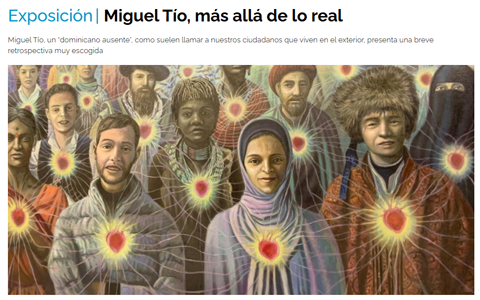
The Exhibition Miguel Tío's painting is striking for its academic mastery, worthy of a classical painter: assured anatomical drawing, virtuosic draftsmanship, precise and refined brushwork, a rich and nuanced palette, and smooth, luminous surfaces, though subtle transparencies and areas of greater density also appear—sometimes only in the smallest details. Yet technical perfection and the visual pleasure offered by Beyond the Real are not enough for the artist. It is evident that his style does not confine him to the coldness of hyperrealism. Equally, if not more important, are inner expression, spirituality, and the pulse of the soul. It is equally evident that Miguel Tío skillfully commands the traditional genres of painting: still life, landscape, and portraiture. His still lifes, whether depicting fruit or flowers, are modest in subject yet exquisitely executed. His landscapes, with their infinite horizons, become boundless stages that seem to extend beyond all limits. Portraiture stands at the forefront of his artistic achievement, unmatched within the scope of his research and production. While living in the United States, Miguel Tío painted portraits of well-known public figures. His portraiture also includes self-portraits. One in particular captivated us: the artist surrounded by little black cats. Another, in which insects cover his cheeks, forehead, and neck, conveys a profound sense of union and fusion with nature. Above all, however, the human body—synonymous with life itself—is his favorite subject. Through the human figure, the artist communicates his mysticism, his ideals, and his utopian aspirations. Thus, music—its notes and magical flight—escapes from the soloist and instrument, from the singer and her voice, ascending toward the heavens. His portraits may depict a single individual or many. In his crowded compositions, we delight in countless tiny portraits, each distinct despite its miniature scale. Miguel Tío believes in solidarity, peace, and happiness shared by all, regardless of origin, race, or religion. Several small paintings affirm these convictions, yet they possess a greatness as vast as the universe itself. He longs for an infinite human community—a future that brings all people together without distinction, men and women alike. He envisions an open, radiant future that remains unknown today.
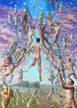
A Message This is not religious art, nor is it inspired by any particular faith or devotion to divine worship. Rather, we perceive it as the artist's own form of mysticism. His angels belong to him alone, rising toward his ideals; their wings embody faith in humanity itself. He believes—or perhaps hopes—that body and life, heart and soul, can together attain peace and happiness for everyone. This is how we read his paintings and the message conveyed throughout this retrospective. Time has only strengthened his convictions and deepened their pictorial expression. Miguel Tío possesses his own "heaven," and his visions, rendered on canvas and paper, reveal the depths of the self while celebrating the universality of the human spirit. He does not seek the privilege of divine grace or mystical ecstasy. Instead, he aspires to a happiness, a serenity, and a fulfillment shared by all.
Coda Ultimately, Miguel Tío has claimed—and invites us to claim—a vast, all-encompassing cosmos, fully revealed in this retrospective exhibition presented by the National Gallery of Fine Arts. May all lovers of fine painting come and experience it.
@Miguel Tió: Floating Connections By Luis Fernando Quiroz. For the book: Journey of a Visionary Artist, Published in 2026 by Miguel Tio Costa Rica, November 2025.
The painting of
master Miguel Tió—born in Santo Domingo, Dominican Republic, and based in
the mecca of the Big Apple, New York—achieves a high level of technique and
command of symbolic resources, languages characteristic of the hybridization
processes that sustain contemporary art.
Nesting the Self
The Rigor of
Portraiture As I stated, his works say more than simply presenting a well-executed painting of impeccable technique, the result of hours and hours of dedication in the studio. He selects symbolic connections that refer to human systems such as psychology, critical thought, creativity, and/or the depths of being, with a certain dose of rebellion that characterizes the great masters of art across time.
Some Earlier Readings I also wrote: “Elements of language such as shells, carapaces, snails, fish, and other marine flora reinvented by the artist—with the play of transparencies, superimpositions, and against-the-grain directions—intensify the enigma within the oneiric territory in which the poetry of these subjects in idyllic submersion is revealed, piercing the viewer so that they turn their gaze toward their own dose of poetry.”
This discourse—and with it I close this brief reading of his work—locates and reaffirms his origins, his Caribbean culture, a reference to the introduction or Yoruba influence brought to the Caribbean by enslaved Africans during the colonial era for the cultivation of sugarcane, introducing that symbolic marine lexicon (the orisha deity Yemayá, goddess of the seven seas of the world) and the major confrontations such as South-South tensions and the neo-filibusterism of the neo-hegemonic powers that still persist, becoming heated discourses for art. LFQ,
@The
Journey After By Henryk M. Fantazos on 20 June, 2009. Visionary tribe I praise your art because you, among a good handful of others, create serious visions. So much of the "surreal" art is no more than embarrassing visual jokes. Huge difference there! Painting should radiate vital commitment to a profound vision and your art surely has it.
@Haunted
Room By Henryk M. Fantazos on 19 June, 2009. Visionary tribe Miguel- congratulations! Quality of your workmanship makes you a Painter and I happen to believe that it is by far more important to love and master our craftsmanship than have great visions without any serious skills to express them. That is why your paintings are so successful!
@The Watcher
By Denis Peterson. November 24, 2007 Deviantart
Paintings of water have always seemed to beckon an unleashed
power from within. It is an entire subject in of itself regarding healing,
bonding, uniting, cleansing and renewal; yet this work is more than a singular
theme, and certainly could be more than one painting as well, on any number of
levels.
@Art
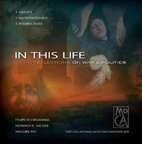
of war - Exhibit offers views of 9/11, Iraq By Cara O'Brien Loveland Reporter-Herald October 5, 2007
By Jeanne Schoaff. Director of Programs, Museum of contemporary Art (MOCA) Fort Collins, Colorado. September 2007
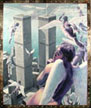
@8:30 AM By Denis Peterson. June 1, 2007 Deviantart This is an epic piece by anyone's standards. The perspective and depth of field leave one's sense of balance somewhat interrupted. I think that if I were to see this one up close, I would need to hold onto something to keep standing. This is a modern Renaissance work with perfect foreshortening technique and an almost silvery glow throughout the muted color scheme.
By Ed McCornack, September/October, 2006 Gallery & Studio Magazine
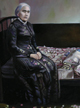
In an era where one would think we would all be shock-proof, some viewers may still be shock by the absence of irony in Miguel Tió`s solo show “Unseen Sides”, at Gallerie Icosahedron, 27 North Moore street, in Tribeca. On view through October 14th, with a reception for the artist from 6:30 to 9:30 PM on September 7th (which will also feature a performance by the classical pianist Yukiko Tanaka), this exhibition breaks what may be our last taboo: the cool postmodern prohibition against the expression of genuine passion. One refers not to sexual passion of the ineffectually salacious kind that permeates our advertising and every aspect of popular culture, barely raising an eyebrow, but to the passionate conviction that art, when it embodies heartfelt emotion, can have a transformative effect on our way of viewing the world. Yet there is also an unabashed sensuality in Tió`s paintings that compels him, in an artist`s statement to issue the following disclaimer “Some of my works explore a range that consist o traditional religious dogma and prejudice at one end, and the instinctive and emotive nature of human sexuality on the other. Though these two subjects are traditionally contrasted as being poles apart, I aim to demystify the prejudice and preconception which divide them, and instead. seek to bridge them through a contemporary interpretation that is rational, thoughtful and honest, as well as spiritual and sacred. This interpretation is never intended to be controversial or offensive, but rather conciliatory and revealing.” Tió, grew up in Santo Domingo, in the Dominican Republic, where he attended the School of Fine Arts, cites Goya and Dali as formative influences. However, he can also be compared with Paul Cadmus for his refine technique and his classical treatment to the nude figure, as well as his argument for sexual diversity. And his unembarrassed visionary tendencies call to mind the great British painter-poet William Blake. Among some forty masterful executed paintings, pleading in various ways for tolerance, peace, and what Tió calls “the transformation of the old beliefs into new ones,” one of the most persuasive is the triptych “Adams and Eves”. Its three panel juxtaposing images of nude gay male, and lesbian couples and the traditional heterosexual pair in an Eden populated by jungle cats and angels, where the serpent morphs into an erect penis as multitudinous apples rain from the sky. Before being taken up by Gallerie Icosahedron, a venue that champions contemporary surrealists, Tió apparently had difficulties finding acceptance in an art world where the mythic is permitted only when it is qualify with an ironic wink, where a painter to wishes to be taken seriously must disavow any eccentricity that fall out-side consensus reality or the dictates of so-called sophisticated taste. Despite--or perhaps, in part, because of—an impeccable technique and drafts-manly gifts that harks back to the Old Masters, he was forced to develop in solitude, and his estrangement from the contingencies of the art world appears to have strengthened the fierce independence of his vision, enable him to create paintings as personals and strangely affecting as “My Mother and Her Invisible Helpers.” Here a handsome silver-haired matron. Wearing a dress decorated with esoteric symbols, such as an eye within a pyramid, a graphic human heart encircled by the points of a compass, and a Christian cross, sits serenely in an armchair, surrounded by phantom-like “spirit guides.” It is a painting fully equal to the best self-portraits of Frida Kahlo, and a fitting tribute to a woman whom the artist credits with introducing him to the spiritual life, “although” Considering were living in a very religious country and in consequence with many taboos it was something that has to be kept in utmost secrecy. Indeed, Tió has such faith in his mother`s intuitive power that he phoned her in Santo Domingo while working on his painting “Moments of Inspiration” and incorporated monkish robed figures she had seen in her “visions” into this portrait that the artist at his easel, painting a Christ-like face, while an unknown painter from an earlier era, encountered on his own meditation (“probably Italian”) gazes over his shoulder, guiding his hand. Various other mystical personages, as well, emerges from the shadows of the studio and are joined by a contrastingly palpable and remarkably intelligent looking black cat, sitting on his haunches attentively watching the progress of the creative process. The confluence of the earthly and the unearthly, of down-to-earth-details and transcendent elements, reaches its apex in the magnificent composition that Miguel Tió calls “8:30 A.M.” This is a panoramic bird`s eye view of many angels soaring from all directions toward the still-intact Twin Towers of The World Trade Center, rising high above the surrounding buildings, the luminous blue river, and the distant shores of one of the outerlying boroughs, mere moments before the terrorist attacks of September 11th, 2001. It is a daring, almost impossible subject for any contemporary painter to attempt, given the historical impact of the events of that morning and their emotional reverberations. Yet Miguel Tió succeeds against all odds, skirting banality by virtue of his ability to convey genuine sentiment where other might find only mawkish sentimentality. Obviously, Tió shares with the Old Masters not only impeccable technique but a belief in the supernatural that has largely fallen by the wayside in our mundanely scientific age. Therefore he is able to paint angelic figures convincingly, even while imbuing them with all the anatomical attributes of actual, beautiful human bodies. And in the face of this ability, the viewer is able to suspend disbelief and to at least symbolically envision an uplifting denouncement to the most terrible of tragedies, as the celestial rescuers arrive, ready to carry the souls of the soon-to-be-victims off to safety in the spirit world.
@ By Scott Everinghan 08/05/2006 (Deviantart.com) A great figurative painting with all the workings of a dream. Forbidden Face by Miguel Tió exemplifies reproducing memory into mastery.
By Joan Lluis Montañés Arte Iberoamericano Contemporáneo Argentina, 2005
@ MIGUEL TIÓ by Ricardo C. Lescano Grosso Argentina
Miguel Tió is a
symbolic artist. A passionate for the universe, because the universe is in
the work, he leads us to think: How would it be possible that I am fair when
I look at his work, within reach of my hand, when I am rather skeptic about
the spirituality? Another representation could be brought to a closer
interpretation of God or spirit, but I suppose that still those ones who are
less susceptible to spiritual states would agree that the symbol or the
spirit have something in common with the painting. Raw material and spirit,
in this case, go hand in hand, and they run inch by inch, for some arriving
first the matter, first the spirit for others. But, together in the pictorial space, simply supported in the color and the depth of the figures and the background, either they confront or they join, according to what we want to interpret, the symbolic or the spiritual model to contemplate the art, perhaps for Miguel Tió, a mixture of materiality and spirituality which is typical of life. The work installs itself, connecting this opposite rebound of the matter and the spirit through the painted space, unequal births and convergent intentions that cause a vigorous and inevitable emotion. The painting of Miguel Tió is so symbolic that still those ones who are less susceptible to spiritual states would agree that the sky, the bled hearts, the angels and so many other figures on the canvas are part of his constant realities. Ricardo C. Lescano Grosso
@
The subject combine with the perfect quality of the technique, are more than
10/10
By Diane Tremblay, 3/16/04 (Critic's Corner at Fine-Art.com)
Really interesting to see your vision just before ... for me it's the best representation of the event I ever saw till now. Il y a quelque chose de tres reconfortant dans cette image. Merci.
@ Another great Work By Michael Sprouse, 3/16/04 (Critic's Corner at Fine-Art.com)
This is by far, the best 9-11 work that I have seen and I have
seen LOTS of it.
M. Sprouse
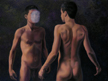
@ By Michael Sprouse, 3/16/04 (Critic's Corner at Fine-Art.com)
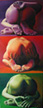
1: It is wonderfully rendered. The forms are brilliant with your
use of light and subtle shadow. The lines on the palms and feet of the subject
are an exercise in subtle communication as they work on so many levels, Not only
as skin wrinkles, but you have somehow managed to capture great emotion in them,
they remind me of the ripples formed on the water after a pebble has been
dropped on the surface. The composition is perfect in these works and works to
use the entire body as a form of communication. I know that there are those out
there who will dismiss this work as individual scenes of someone's ass in your
face and that is a pity. In my opinion, you have very successfully used
non-traditional figurative imagery to relay traditional communication themes,
forcing the viewer to formulate an opinion and a reaction.
M. Sprouse
@
By David Baker, 2/25/04 (Critic's Corner at Fine-Art.com)
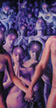
The various depictions of hands clasped is particularly powerful, as is the nakedness of the figures. There is something vulnerable and human about this entire image. It is also a highly spiritual piece, both in form and colour. I am not at all religious myself, but if I were I would more than likely have my faith reinforced by this wonderful piece. David B.
@
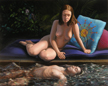
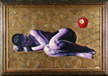
By Stephen W. Mcdermott, July 2003 (For Gay City newspaper) Miguel Tió`s Eve (oil and gold leaf on cutout canvas) is a large, oblong canvas superimposed on another, cut out to reveal a lower image of a female figure lying in modified fetal position. The over canvas is a series of rows of golden apples, broken in the upper right corner by a single, Red Delicious apple, with one bite taken out. @ By James Pinney, June 2003 (For the "Guilty pleasures" show) Miguel Tio (paintings), "Lovers", "Tears", and "Attitudes", dramatic and complex portraiture, irresistibly sensual and illusionary, which exploits scale and luminosity without eschewing the personal and the poetical, work that entices the eye and rewards the minds. @ Miguel Tió: BETWEEN FIRE & WATER / LIGHT & SHADOWBy Luis F. Quiroz, January 2000 Inside the different visions and diversity of language in today's art world, the work of this artist attempts something more than the dominion of his craft - superb draftsmanship, a rigorous technique with empathy for chromatic components that accent his pictorial formality, containing the nude form submerged in surrounding antagonistic readings: Water/Fire, Light/Shadow, Masculine/Feminine, imminence/Rupture. Maybe what I like the most of Tio`s work is this concept of confronting the conflict of opposites, resolving for us the unity, the ties, the nexus with the fragmented which creeps into the recesses of our memories and dreams... In his work “Dualism” ( oil on canvas, 22”x36”, 2000 ) he assumes the coexistence of two beings into one; like that feminine/masculine side that we all possess and which is folded one inside the other in continuous self flagellation, all happening in cautious harmony In the piece “Meditation” ( oil on canvas, 30”x40”, 2000 ) the subject in total submersion is a metaphor of the human which dwells in the conflicting psyche; a vision of a diminutive being thrown into the abysmal and the eternal subconscious as if to succumb to his fate; naked inside that shell that we all adopt in life in order to make everyone else accept us into society: myth and technique of frugality, glamour, and mirages, a body being exhibited in a display window: scenic display case for a “product/subject” exposed to immediacy, dressed up with the blinding mother-of-pearl of consumerist society which vacillates in that abysm where desire and the morbid are the seducers. The piece “Yin Yang”( oil on canvas, 30”x40”, 2000 ) , is evidence of the magic and drama charged into two feminine bodies “Water” and “Fire” which are themselves a simple body intertwined in a tense conjunction by the umbilical cord, (one is a shadow and the other is light) indivisible complements which advance both entities into the commensurate enclave of the “ to be” or “ not to be”
@"Apocalipsis" o las posibilidades de Miguel Sánchez Tió Por Marianne de Tolentino. Listin Diario, Republica Dominicana, Miercoles 17 de Agosto, 1988
|